Monday, December 10, 2012

"The Hate List" by Jennifer Brown


2009 edition cover, courtesy of TinasBookReviews.com

                With a title like "Hate List", the reader immediately gets a sense that this isn't going to be a happy story. It revolves around the struggles of high school student Valerie, whose boyfriend Nick went on a shooting spree at the their high school. What began to Valerie as a way to vent her frustrations with bullies, her parents' relationship difficulties, and other life issues turned to tragedy when Nick took the Hate List they had written and used it as a list of targets, causing many people in her community to see her as an accomplice to the attack.
                "Hate List" is told through two timelines: the present Valerie who must deal with seeing people whose lives were changed after months in recovery and the past Valerie who is figuring out how different her life has become immediately following the disaster. Each chapter also begins with a miniature news article covering bits of how the shooting played out. As she returns to school, Valerie is forced to confront people who see her as a threat and struggle with her own emotions as she grows to feel that even those people she thought loved her most, her family, believe her to be a public menace. Valerie struggles to get on with her life with the support of her therapist, Dr. Hieler, who gives Valerie someone to talk to who won't judge or condemn her, and Stacey, the girl whose life Valerie saved, is the girl who first told the police that Valerie was innocent of any wrong-doing, and who works with Valerie to come to grips with her feelings about school.
                "Hate List" is a darkly emotional book with a hopeful ending that shows that even the most dire of stigmas can be overcome with love and support. It also emphasizes that people shouldn't try to deny their feelings for the sake of other but they should also not let those emotions control what they do. "Hate List" almost shows that there are two sides to everything, even people who are considered to be total monsters.


This book has won the following awards:
School Library Journal Best Book of the Year
Michigan Library Association's Thumbs Up! Award
Louisiana Teen Readers Choice award
ALA Best Book for Young Adults
2010 Thumbs Up! Winner
2011 Arkansas Teen Book Award
2012 Oklahoma Sequoyah Book Award
VOYA "Perfect Ten"
YALSA 2012 Popular Paperback

Brown, Jennifer. Hate List. New York: Little, Brown, 2009. Print.

"Steve Jobs: The Man Who Thought Different" by


book cover, courtesy of behance.net

                It would be hard to believe that anyone in the United States hasn't heard of Steve Jobs and the Apple corporation's amazingly successful iMac, iPod, and iPhone products. Fans of these products would know Steve as a visionary, a man who makes miracles happen like a member of the Olympic pantheon. This biography, "Steve Jobs: A Man Who Thought Different" by Karen Blumenthal, builds upon that reputation for innovation but also presents the darker side of Steve Jobs: the demanding taskmaster, the less-than-doting father, and stubborn leader.
                As biographies are often want to do, this one begins at the moment Steve was born and put up for adoption by his mother, who made Steve's adoptive parents promise to send the boy to college after he graduated high school. Steve's childhood of mischief and creativity set an early stage for his dual-natured life of brilliance and stubbornness. It was also during this time that he learned from his adopted father, Paul Jobs, the first of two important lessons he would live his life around: always do everything correctly, because even if nobody else notices something wrong, you will always know.
                Steve's second important life lesson would come in his late-teens/early-20s. As his biological mother requested, Steve Jobs went to college, but only for a single semester when he decided he would rather pursue and study ideas of his own than adhere to a strict class list dictating by the college he went to. Steve began visiting religious orders and experimenting with his diet to try to find enlightenment and, according to some of his friends, a cure to a suspected sense of abandonment Steve felt for his parents. It was during a visit to a Buddhist temple that Steve learned his second lesson: live every day as if it were your last but always plan as if you know tomorrow will come.
                That Steve Jobs managed to become one of the richest and most successful men in the world should serve as an important reminder to everyone, especially teens, that success can be achieved as long as a person has motivation and persistence. While not everyone can be quite that successful, the reader should also keep in mind that while Steve earned a lot of money and was famous, he was widely regarded by his peers as being lousy at personal relationships, including with his family, so keep in mind that how much success you achieve is equal to the price you're willing to pay.

Blumenthal, Karen. Steve Jobs: The Man Who Thought Different : A Biography. New York: Feiwel and Friends, 2012. Print.


"The Book Thief" by Markus Zusak


eBook cover courtest of effyeahnerdfighterbooks.tumblr.com


            ”The Book Thief" is the story of a young German girl named Liesel Meminger and is narrated in a disjointed, conversational style by Death, though he is not explicitly named during the story. The book begins when Liesel is nine years old and she, her mother, and her brother are en route to a foster home for the two children. The narrator introduces himself as Liesel's brother dies and is in need of processing. It is as she watches her brother's brief, small funeral that Liesel experiences the first of many future book thefts: a gravedigger's assistant drops his copy of "The Gravedigger's Handbook" and, even though she doesn't know how to read, is compelled to take it from where it lies in the snow.
            Books take on an important symbolism throughout the book as signs of defiance. "The Gravedigger's Handbook" is Liesel's refusal to accept her brother's death. "The Shoulder Shrug" is Liesel's first chapter in her small, civil disobedience against the Nazi regime. Even Max Vandenburg, a Jewish street fighter on the run, uses books to oppose the government by using a copy of "Mein Kamph," Adolph Hitler's autobiography, to appear to the police as a loyal German citizens and then later writes over the book, erasing Hitler's words with his own to show his gratitude towards Liesel for keeping his secret and as a means to show the government that even a man with nothing to his name can find ways to spread happiness. Even Liesel's life story serves as a means of defiance, allowing her to cheat death and inadvertently survive a bombing run that manages to kill every other person still living on her street.


This book has won the following awards:
2006 - Commonwealth Writers Prize for Best Book (South East Asia & South Pacific)
2006 - Horn Book Fanfare
2006 - Kirkus Reviews Editor Choice Award
2006 - School Library Journal Best Book of the Year
2006 - Daniel Elliott Peace Award
2006 - Publishers Weekly Best Children Book of the Year
2006 - Booklist Children Editors' Choice
2006 - Bulletin Blue Ribbon Book
2007 - ALA Best Books for Young Adults
2007 - Michael L. Printz Honor Book
2007 - Book Sense Book of the Year
2009 - Pacific Northwest Young Readers Choice Master List

Zusak, Markus. The BOOK THIEF. NY: Thomson Gale, 2006. Web.

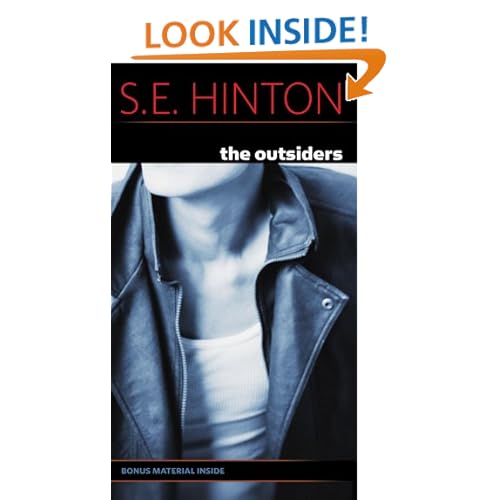
"The Outsiders" by S.E. Hinton


eBook cover, courtesy of Amazon.com

            For many years, "The Outsiders" by S.E. Hinton has been a common sight in middle schools as required reading. What is it about this tale, first published in the 1960s, that gives it the power to be so timeless? A story that begins with a young man being ambushed on his way home from the movies has a powerful message at its core: be true to who you are and don't let outer forces pressure you into being someone else. This moral is frequently applied to characters through the book, showing the consequences of betraying yourself and the cleansing nature of staying true to yourself. Ponyboy, the main character, frequently struggles with himself, trying to figure out who he is while being assailed on all sides by other people who seek to define him by their terms, like Greaser and Hood and, towards the end, Hero. He resents the titles and stereotypes that society imposes on him while at the same time embracing these traits as a means of giving himself an identity and a way to feel like he belongs somewhere.
            It is only after reading his deceased friend Johnny's final words that Ponyboy begins to understand what being true to himself means. Only he, Ponyboy, can truly decide what it means to be Ponyboy. No matter how much he may think he has become a "hood," he is the one who decides whether or not that he will do things to help others, from grand actions like saving children from a burning building or small gestures like picking up glass in a parking lot so nobody will have to replace a damaged tire.


This book has won the following awards:
New York Herald Tribune Best Teenage Books List, 1967
Chicago Tribune Book World Spring Book Festival Honor Book, 1967
Media and Methods Maxi Award, 1975
ALA Best Young Adult Books, 1975
Massachusetts Children’s Book Award, 1979

Official Trailer for Warner Brother's film rendition of "The Outsiders": http://www.youtube.com/watch?v=8tgJqnVMAtc

Hinton, S. E. The Outsiders,. New York: Viking, 1967. Web.