Thursday, December 13, 2012

"Last Stand of the Wreckers" by Nick Roche

Hardcover, courtesy of IDWpublishing.com

               What do an obsessed fanboy, an eager gun enthusiast, a delusional hero worshipper, and a narcissist with an inferiority complex have in common? They're the newest members of the Autobots' elite special forces team, The Wreckers. "Last Stand of the Wreckers" by Nick Roche is the story of these four Autobot newbies on their first mission as Wreckers as they follow Transformers veterans Springer, Kup, and Perceptor on a suicide mission to liberate the Autobot prison planet, Garrus-3. What awaits them is one of the most powerful Decepticons in the galaxy, Overlord, who has turned the planet into his personal playground, pitting Autobot prisoners against the Decepticons they formerly imprisoned. What awaits the Wreckers is more than just danger, but a conspiracy that has its roots amongst the highest echelons of the Autobots' leadership.
                "Last Stand of the Wreckers" is an exciting story that puts a twist on a classic science fiction trope. Many stories often feature a new member to an established team, such as Star Trek's away teams, that often goes unnamed or is given little backstory. These characters often serve to be killed off to give the story a sense of peril. Rather than follow the popular characters, "Last Stand of the Wreckers" follows the replacement members as they deal with the dangers of...well...being the replacement members. Will they die? Almost certainly. Will you care that they died? Definitely.
                I spoke with Will, a Freshman, about graphic novels and he said his favorite stories are ones that are funny and exciting, and without a doubt "Last Stand of the Wreckers" has both. I would definitely recommend this story to fans of Transformers and also to people who like nasty bad guys, snarky good guys, and nonstop action. You don't need to have a huge amount of knowledge to enjoy "Last Stand of the Wreckers" and every character you need to know more about is given an informative profile written from an in-universe perspective. "Last Stand of the Wreckers" also includes a cover gallery, an art gallery, character profiles, and several prose short stories that serve as prequels or sequels to the main story.


Roche, Nick, James Roberts, and Guido Guidi. Last Stand of the Wreckers. San Diego, CA: IDW, 2012. Print.

"A Wrinkle in Time" by Madeleine L'Engle


                I read "A Wrinkle in Time" by Madeleine L'engle once before when I was in the 4th grade. When I had the opportunity to read it again, I eagerly took it because I remember not understanding the story very well. I had hoped that having almost 20 more years of experience in reading and knowledge would better prepare for me to understand the story and to understand the significance of its symbolism. It's also a very simple book to read: the pacing is very fast in most parts of the book and new characters are given very little description upon introduction.

               "A Wrinkle in Time" is the story of a strange interplanetary search undertaken by a girl named Meg Murray, her brother Charles Wallace (rarely is he referred to as simply Charles), and a boy with strange psychic powers named Calvin. The three are whisked across space and time by a trio of strange shapeshifting aliens called Mrs. Whatsis, Mrs. Who, and Mrs. Which, who have the power to teleport to other worlds and dimensions. They eventually find Mr. Murray, who accidentally teleported during a mission for the government, to a planet called Camezotz, where a giant brain has enslaved the populace somehow.

               For a science fiction book, "A Wrinkle in Time" uses a lot of religious symbolism in strange ways. Particularly religious readers may want to keep this in mind, for this book has such oddities as winged centaurs who sing hymnals, blind tentacled aliens who thank God for their ability to resist evil, and - strangest of all - stories of Jesus fighting an alien evil alongside Leonardo DaVinci and Albert Einstein. I think the symbolism is very poorly used.

               Another problem I have with "A Wrinkle in Time" is that the pacing is very fast. The longest scenes in the book are, ironically, the least-important while important scenes such as confronting the villain of the book and the ending are covered in about five pages. The ending itself is about half a page and comes to an abrupt halt with almost no explanation as to how it occurred.

                I would not strongly recommend this book. It has some interesting scenes, but is not particularly thought-provoking and the characters are not very deeply characterized except for Meg, Charles Wallace, and Calvin.

"A Wrinkle in Time" is the first book in a five-book series referred to as the "Time Quintet." It has also been adapted into an opera in 1992, a Made-for-DVD movie in 2003, a play in 2010, and a graphic novel in October 2012 (barely two months before this review). 


This book has won the following awards:
1963 Newberry Medal
1964 Lewis Carroll Shelf Award
1965 Sequoyah Children's Book Award

If you enjoyed "A Wrinkle in Time" check out the other books in the Time Quintet (in order of release date):
Book 2: "A Wind in the Door" (1973)
Book 4: "A Swiftly Tilting Planet" (1978)
Book 3: "Many Waters" (1986)
Book 5: An Acceptable Time (1989)

You might also be interested in the "A Wrinkle in Time" graphic novel.

Check out the "A Wrinkle in Time" movie trailer: http://www.youtube.com/watch?v=vdjShe0ouiw

L'Engle, Madeleine. A Wrinkle in Time. New York: Farrar, Straus, and Giroux, 1962. Print.

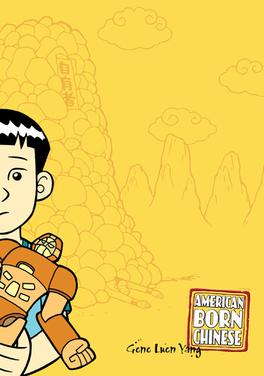
"American Born Chinese" by Brian Katcher


Book cover, courtesy of Wikipedia

               "American Born Chinese" is three stories relating to growing up with a different heritage, Jin Wang, a boy who moved from the primarily Chinese neighborhood where he was born to attend a primarily Caucasian school, the Monkey King, who desires to become more than a monkey through force, and Danny, whose stereotypically-Chinese cousin comes to visit him for a week, in a graphic novel format.  Each struggles to overcome racial stigmas that he feels are being applied: Jin Wang feels isolated by teachers who can't get details of his life correct and classmates who make racist remarks or try to keep him from associating with them on the basis of his Chinese heritage, the monkey king feels that he is entitled to greatness that others deny him for being a monkey, and Danny feels that his friends and classmates look down upon him because of how closely his cousin fits Chinese stereotypes. The three stories eventually tie-in in a strange twist that is provocative and thoughtful.
                "American Born Chinese" is a great story for teens because of the central theme of trying to figure out who you want to be, whether it's to be who you are or a person who fits society's view of what an acceptable person to be is. While this book is fairly light-hearted with racist imagery, the moral does remind me of "Almost Perfect" by Brian Katcher, which was decidedly darker with a less-happy ending. Both "American Born Chinese" and "Almost Perfect" emphasize that being true to one's nature will result in a happier life, but it can often be harder not to live a lie.
                Fun fact: the story of the monkey king, an old Chinese legend, inspired the famous anime Dragon Ball. The similarities are especially obvious with Dragon Ball's protagonist, Goku, a boy who knows martial arts, has an extending staff, and transforms into a giant ape. Also, the pictures of Transformers seen early in "American Born Chinese" are accurate depictions of actual Transformers toys from the 80s.

This book has won the following awards:
2007 Michael L. Printz Award


The opening theme for Dragonball, an anime based on the legend of the Monkey King: http://www.youtube.com/watch?v=BT1Dp69D7q0


Yang, Gene Luen. American Born Chinese. Parma: Guanda, 2006. Print.

"Aya of Yop City" by Maguerite Abouet


Book cover, courtesy of Drawnandquarterly.com

               Despite its title, "Aya of Yop City" by Marguerite Abouet is not about what happens to Aya, even though she's the title character. It would be more accurate say that this graphic novel is about Aya, a student of medicine, as she helps her friends deal with beauty contest and children and her family deal with the pressures of her father's office job. This book offers a look into the life of the middle class in an African village (more like an American small town than what is typically thought of as a village) during the 1970s, including negotiating marriages, trying to deal with local beauty contest, and plenty of extra-marital affairs resulting in unexpected children.

                "Aya of Yop City" is a clever book with plenty of real-life drama. The author also does a service for readers who, like me, haven't read the first "Aya" graphic novel ("Aya of Yop City" is book two) by providing a listing of returning characters that is not only illustrated but also shows how each character relates to one of the main members of the cast. Other bonus features include a glossary of unfamiliar African terms, such as Claclos (a kind of dumpling) and Koutoukou (an alcoholic beverage), instructions for making a chicken dish seen in the story and how to carry a baby on your back as Aya does that are written in-character, and an interview with the author (her husband is the illustrator).

                I would recommend "Aya of Yop City" mainly to teens who either enjoy soap opera-style dramas or who want some insight into how people lived on the Ivory Coast during the 1970s. Though there is some humor, this book's style of excitement revolves around revelations of personal drama.

Fun fact: An animated film based on this graphic novel was released in France in May of 2012.

If you enjoy "Aya of Yop City," be sure to read the other books in the Aya series:
Book 3: "Aya: The Secrets Come Out"
Book 4: "Aya: Life in Yop City"


Abouet, Marguerite, and Clement Oubrerie. Aya of Yop City. London: Jonathan Cape, 2009. Print.